Editorial
DOI:
https://doi.org/10.51247/st.v9i3.821Keywords:
scientific internationalization, educational innovation, digital transformation, global knowledge.Abstract
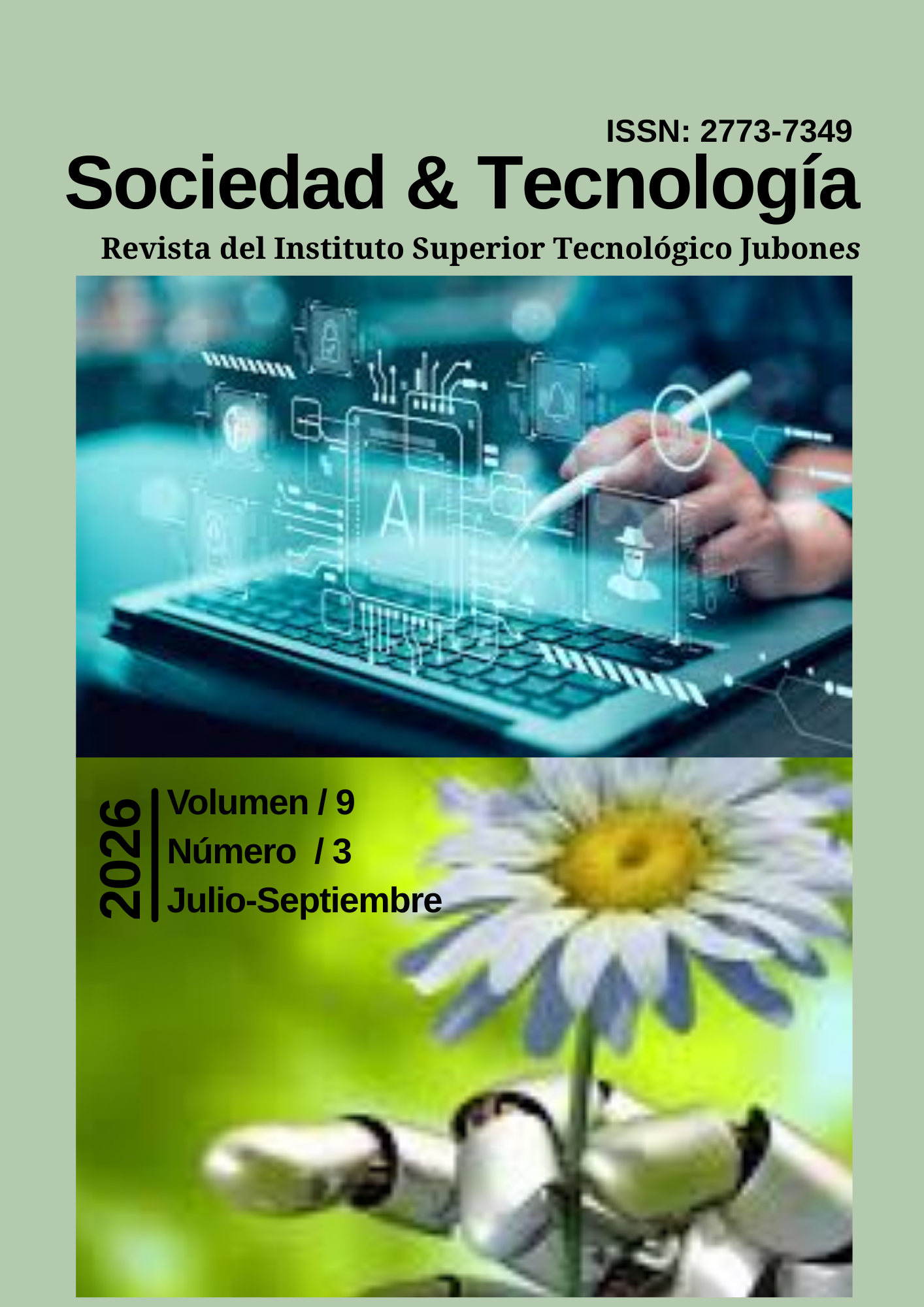
Volume 9, Number 3 (2026) of the journal Sociedad & Tecnología (Society & Technology) brings together a selection of research that reflects the thematic, methodological, and geographical diversity that characterizes contemporary scientific production. The published articles address issues related to digital misinformation in health, public administration, algorithm-mediated work, international politics, artificial intelligence applied to education and tax administration, as well as studies focused on human development, reading, the economy, and digital communication. The participation of authors from Algeria, Iraq, Mexico, Colombia, and Ecuador demonstrates the journal's international reach and impact, aimed at disseminating scientific knowledge and making it available to the global community. This issue reaffirms the journal's commitment to disseminating rigorous, interdisciplinary, and contextualized research capable of generating academic reflection and providing alternatives for addressing the social and technological challenges of the 21st century.
Downloads
References
Bouattoura, F. (2024). Las mareas de la influencia digital: redes sociales y opinión pública en Argelia. Oficina Editorial de Educación Superior en Ciencias Sociales, 26 (1), 28-32.
Bouhoreira, A. (2025). Burocracia digital y transformación del liderazgo administrativo en las instituciones públicas argelinas: un estudio de caso. Revista Al-Siraj de Educación y Cuestiones de la Sociedad, 9(4), 58-83.
Cruz Estrada, I., Miranda Zavala, A. M., & Sepúlveda Moreno, C. O. (2025). MARKETING DE INFLUENCER EN LA DECISIÓN DE COMPRA DE LA GENERACIÓN Z. Revista Conhecimento Online, 2, 154-175.
Guishca Ayala, L. A., Bernal Parraga, A. P., Martínez Oviedo, M. Y., Pinargote Carreño, V. G., Alcívar Vélez, V. E., Pinargote Carreño, V. L., Pisco Mantuano, J. E., Cardenas Pila, V. N., & Guevara Albarracín, E. S. (2024). Integración De La Inteligencia Artificial En La Enseñanza De Matemáticas Un Enfoque Personalizado Para Mejorar El Aprendizaje. Ciencia Latina Revista Científica Multidisciplinar, 8(6), 818-839. https://doi.org/10.37811/cl_rcm.v8i5.14114
Kuhlman, C., Jackson, L., & Chunara, R. (2020). No hay computación sin representación: evitar sesgos de datos y algoritmos a través de la diversidad. Preimpresión de arXiv arXiv:2002.11836.
Montalván-Gaona, A. S., Ortiz-Tinoco, D. E., & Orellana-Ulloa, M. N. (2026). Análisis del uso de inteligencia artificial en la fiscalización tributaria del SRI en Machala: eficiencia, ética pública y evasión fiscal. Sociedad & Tecnología, 9(S1), 171-186.
Moreno Pérez, J. L. (2022). El Institucionalismo americano y la Escuela de Economía del Trabajo y de las Relaciones Laborales: Thorstein Bunde Veblen y la Escuela de Wisconsin. Revista De Estudios Jurídico Laborales Y De Seguridad Social (REJLSS), (5), 20-49.
Morocho Cevallos, R. A., Cartuche Gualán, A. P., Tipan Llanos, A. M., Guevara Guevara, A. M., & Ríos Quiñónez, M. B. (2023). Integración de la Inteligencia Artificial en la Educación. Ciencia Latina Revista Científica Multidisciplinar, 7(6), 2032-2053. https://doi.org/10.37811/cl_rcm.v7i6.8832
Rutherford, J. (2003). Ventanas al mundo de la ciencia: preparación y oportunidad. Revista iberoamericana de ciencia tecnología y sociedad, 1(1), 197-208.
Santana Vega, L. E., Feliciano García, L. A., & Santana Lorenzo, A. (2012). Análisis del proyecto de vida del alumnado de educación secundaria. Revista Española de Orientación y Psicopedagogía, 23(1), 26-38.
Zamora Mendoza, M. E., & Romero Ortega, A. B. (2025). El pódcast como herramienta educativa y la influencia en la motivación por la lectura. LUZ, 24, e1574-e1574.
Zarif, M. J. (2014). What Iran really wants: Iranian foreign policy in the Rouhani era. Foreign Affairs, 93(3), 49-59
Downloads
Published
Issue
Section
License
Copyright (c) 2026 Martha Raquel Morán-Franco

This work is licensed under a Creative Commons Attribution-NonCommercial-ShareAlike 4.0 International License.